
The Philippe Harold
Ring Size Guide
Every ring we craft is measured to the fraction of a millimetre. Use this guide to find your size at home, or reach out and our jewellers in Antwerp will do it for you — free of charge.

What Is a Ring Size?
A ring size is a measurement of the inner circumference of a ring, matched to the base of the finger it's worn on. Philippe Harold rings are made to European sizing — a number that is simply that inner circumference in millimetres — though we also list the UK and US equivalents throughout this guide.
What a good fit feels like
A well-fitting ring should slide over the knuckle with a little resistance, then sit comfortably at the base of the finger without pinching or spinning freely. It should feel secure through a normal day — washing hands, typing, exercising — without needing to be constantly checked.
See Your Size, True to Scale
Every women's size, EU 44 to 61.5 (US 3 to 10), shown at true size. If a ring you own already fits, lay it over these circles — the inner edge of your ring should trace the circle exactly. (Keep your screen at 100% zoom — sizing may vary slightly by device.) Shopping for a men's or larger size? Find it in the full chart below.
Three Ways to Find Your Size
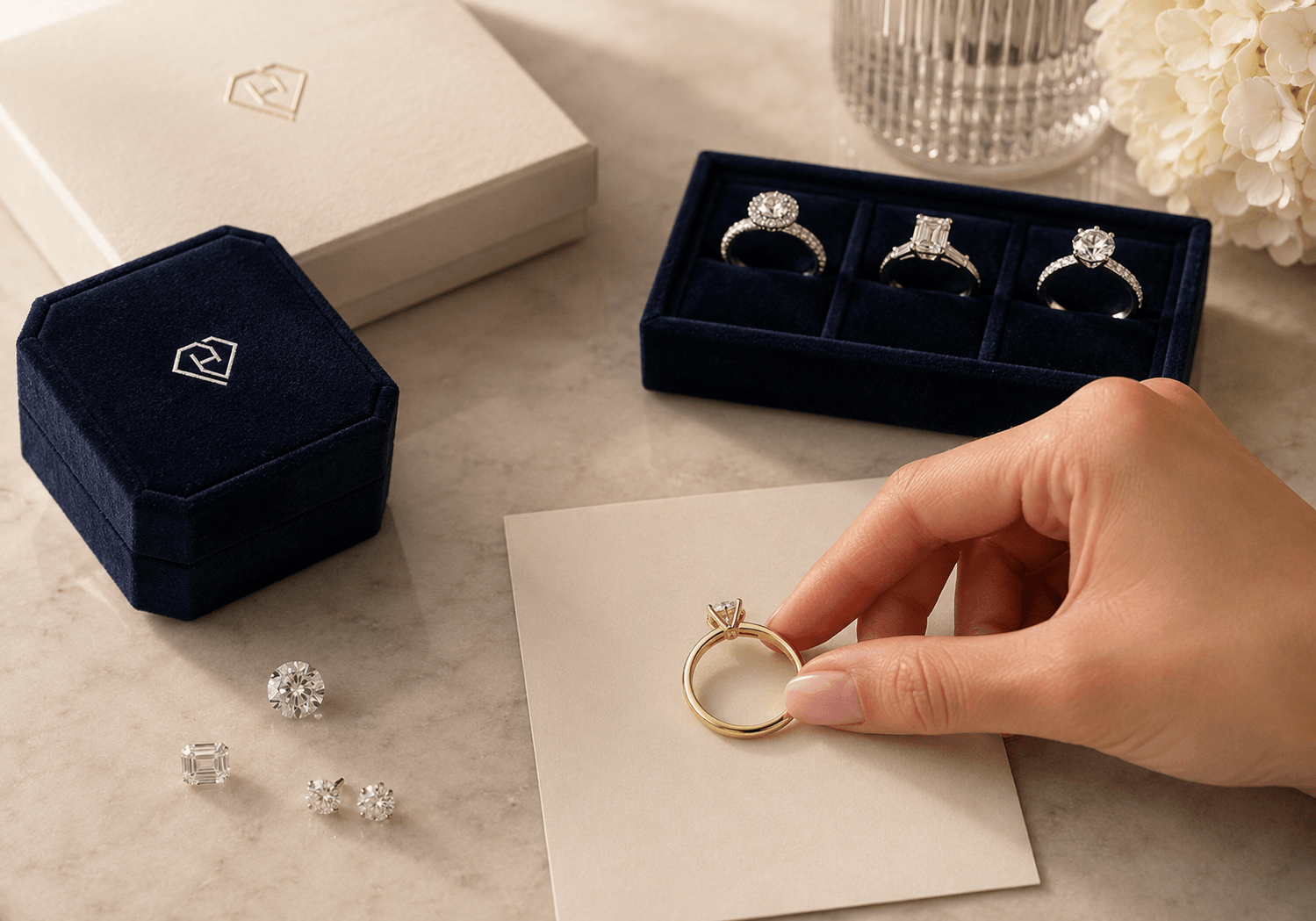
Measure an Existing Ring
Take a ring that already fits the intended finger well. Measure its inner diameter in millimetres, or lay it on the printed circles above, and match it against the chart below. For the most accurate reading, use a ring close in width to the one you're buying — a much wider or narrower band can throw the diameter off slightly.
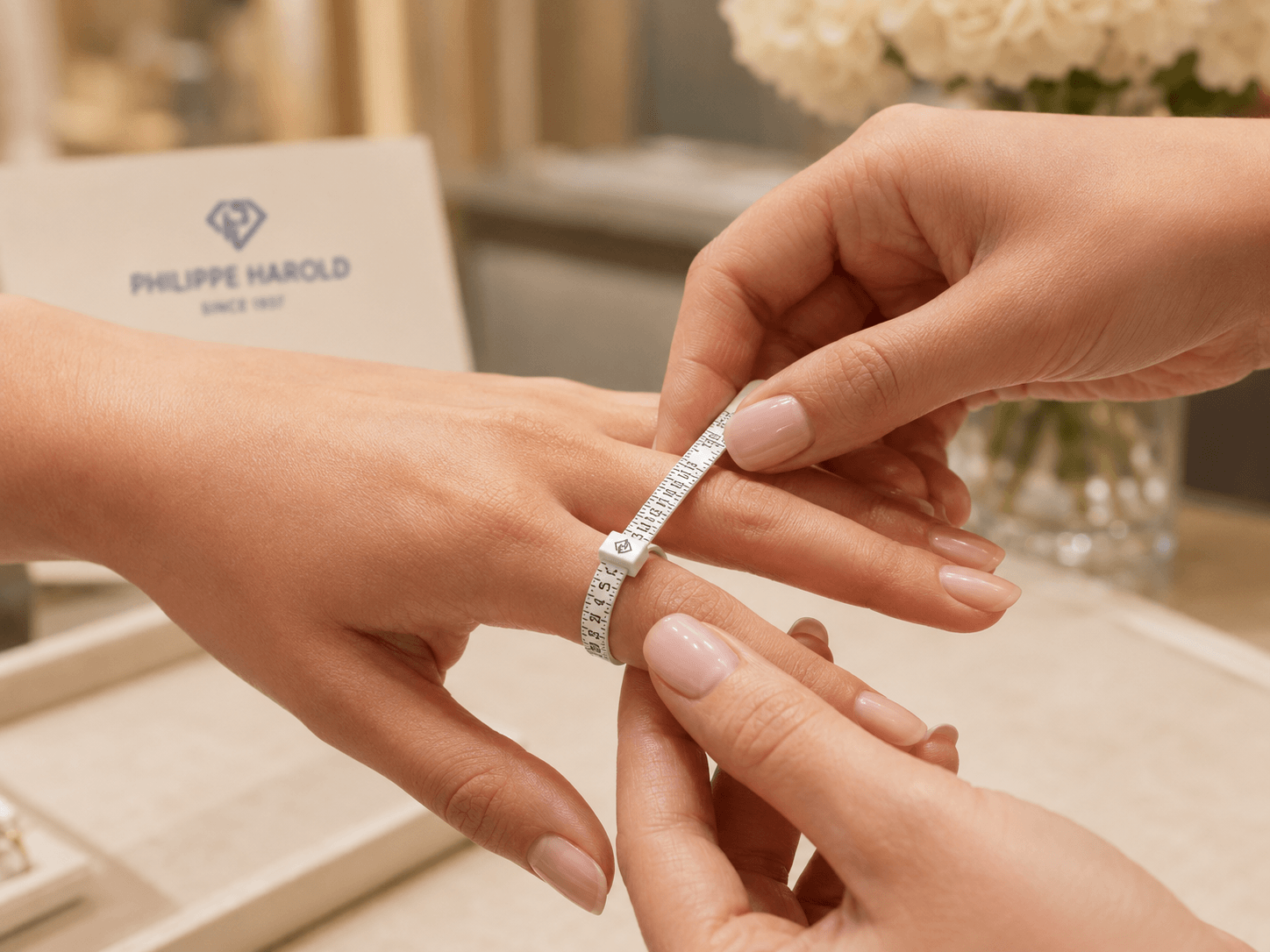
Measure Your Finger
Wrap a strip of paper or thread snugly around the base of your finger, mark where it meets, then measure that length in millimetres. This is your circumference — find it in the chart below.

Visit Our Antwerp Atelier
For a precise, professional measurement, Marcel and our team are glad to size you in person, or guide you through the process during a complimentary online consultation.
How to Measure at Home
No printer needed — just paper or thread and a ruler. If you do have a printer, the sizer below is a quicker version of the same idea, with the scale already printed for you.
-
1
Gather what you need
A strip of paper or non-stretch thread (dental floss works well), a ruler marked in millimetres, and a pen. Avoid elastic, wool, or stretchy string — it's the single most common cause of an inaccurate reading, usually a ring that ends up too loose.
-
2
Choose your moment
Measure in the evening, when hands are at room temperature and their natural size — not right after waking, exercising, or being out in the cold, when fingers measure smaller than usual.
-
3
Wrap the base of the finger
Wrap the strip around the base of the finger that will wear the ring, just below the knuckle. It should sit snug enough to stay in place, but still slide over the knuckle without resistance — that's the fit you're aiming to measure.
-
4
Mark and measure
Mark where the strip first overlaps itself, lay it flat against your ruler, and measure the length from the start to the mark, in millimetres. This is your circumference.
-
5
Repeat, then match your size
Measure two or three times and use the most frequent result — a single reading can be off by a millimetre. Then find that number in the chart below to identify your EU, UK, and US ring size.
Print a Ring Sizer at Home
The same method as above, with the ruler already built in. Download the PDF below rather than printing straight from this page — browsers can silently rescale HTML when printing, while a PDF holds its exact size, and it includes a second page for measuring a ring you already own.
Prefer to stay on this page? A quick on-screen version is below — check the calibration bar first, the same way.
Before you cut anything: hold a ruler against the solid black bar to the left. It should measure exactly 50mm. If it doesn't, open your print dialog, set scale to 100% / Actual size (turn off "Fit to page"), and print again.
The shaded band marks the typical adult range, EU 44 to 69mm. Wrap the strip around your finger starting exactly at the 0 / START mark, mark with a pen where it meets itself, then read the number at your mark.
- Print and confirm the calibration bar measures exactly 50mm.
- Cut the strip out along the dashed border — it's a simple straight rectangle, so scissors are all you need.
- Wrap it around the base of the finger that will wear the ring, lining up the start of the strip exactly with the 0 / START mark, snug but not tight.
- With a pen, mark the exact point where the strip crosses back over the 0 / START mark.
- Unroll the strip and read the number printed at your pen mark. That's your ring size in EU / millimetres — use the chart below to convert to UK or US.
A paper reading is a helpful estimate, not a guarantee — paper thickness and how snugly you wrap both affect it slightly. For an engagement ring or anything meant for daily wear, we recommend confirming your size with us before it's made.
International Ring Size Chart
Philippe Harold rings are made to European (EU) sizing. Use this chart to convert from UK or US sizing, or from a finger measurement in millimetres.
| EU Size | UK Size | US Size | Diameter (mm) | Circumference (mm) |
|---|
EU size reflects the inner circumference of the ring in millimetres, the standard used across Belgium and continental Europe, shown here at every whole millimetre. Because UK and US sizes step in larger increments, you'll sometimes see the same UK or US size listed against two consecutive EU sizes — that's expected, not a typo. Where possible, use the millimetre (EU) measurement directly, as it's the most precise.
What Can Affect Your Ring Size
Your finger isn't a fixed measurement — it changes subtly through the day and over time. Keep these in mind when you measure.
- Temperature — heat and cold both shift finger size temporarily
- Ring width — wider bands sit more snugly than thin ones
- Time of day — fingers are typically smallest in the morning, largest in the evening
- Dominant hand — often half a size larger than the other
- Finger and knuckle shape — a prominent knuckle needs a size that still slides over it
- Pregnancy and hormonal changes — can cause temporary swelling
- Activity level — exercise and heat both increase finger size briefly
A Few Notes on Getting It Right
Measure more than once. Take three readings on different days if you can, and go with the size that comes up most often.
Leading edge or centre? Jewellers measure a ring's size slightly differently depending on the convention used — ask us which we use if you're comparing a measurement from elsewhere.
Ring spinning on your finger? If the size itself is right but the ring still twists, a small internal adjustment — sometimes called a sizing bead — can add grip without changing the size. Ask us about it.
Write your size down. Once you know it, keep a note of it — it's useful again for eternity bands, resizing, or gifts down the line.
Sizes can shift over the years. Weight changes, age, and health can all move your size slightly. Worth remeasuring before a significant purchase, even if you've been sized before.
Common Questions
We generally recommend sizing up. A ring that's very slightly loose is a quick, inexpensive adjustment — a ring that's too tight is a more involved resize, and uncomfortable to wear in the meantime.
Yes. Wider bands (above roughly 6mm) sit more snugly against the finger than a thin band of the same labelled size. If you're between sizes and choosing a wide style, size up by half a size.
In most cases, yes. Get in touch with us and we'll let you know what's possible for your specific design and metal.
They're very close, but not always an exact one-to-one match — each system rounds slightly differently. Where possible, use the millimetre (EU) measurement directly, since it's the most precise.
Borrow a ring they already wear on the intended finger and measure its inner diameter against the chart above, or discreetly ask someone close to them. Height and build can also point to a reasonable starting estimate if you have nothing else to go on. If you're still unsure, get in touch and we'll help you choose with confidence; if the size needs a small adjustment afterwards, that's a normal and easy part of the process.
It's a reliable estimate for most people when measured carefully, following the steps above. For an engagement ring or another piece meant for daily wear, we recommend confirming with an in-atelier or video fitting before it's made.

Not Quite Sure of Your Size?
Our jewellers in Antwerp are happy to measure you in person, or talk you through it over a complimentary video consultation.
